
Powering Primary Maths: Why Teaching Assistant Subject Knowledge Matters

Teaching assistants (TAs)can play an important role in primary mathematics classrooms. Often working with small groups or individuals, they are uniquely positioned to influence children’s confidence, understanding and progress. However, the impact they can make depends significantly on their own mathematical subject knowledge. When teaching assistants have a secure understanding of maths, use precise mathematical language, recognise misconceptions and feel confident using a range of mathematical representations, they become powerful agents of learning.
Why Subject Knowledge Matters…
Primary mathematics is not just about procedures — it is about understanding structures, relationships and reasoning. Teaching assistants frequently support pupils who need additional guidance, which means they must be able to explain ideas clearly, ask purposeful questions and adapt explanations when pupils struggle. Strong subject knowledge allows TAs to do more than supervise with task completion; it enables them to teach, scaffold thinking and develop independence.
When adults are confident in the mathematics they are supporting, pupils benefit from clearer explanations, better questioning and fewer misconceptions being inadvertently reinforced. Conversely, uncertainty can lead to over-reliance on rules without understanding or missed opportunities to deepen learning.
Using Mathematical Terminology Effectively
Mathematical language is foundational to understanding. Words such as factor, multiple, denominator, equivalent, or regrouping carry precise meanings that help pupils articulate their thinking and connect ideas.
Teaching assistants with strong subject knowledge:
- Model correct mathematical vocabulary consistently
- Reinforce the language pupils encounter in whole-class teaching
- Encourage reasoning by prompting pupils to explain using correct terminology and use stem sentences
This consistency strengthens mathematical communication and reduces confusion, especially for pupils who already find maths challenging.

Identifying and Responding to Misconceptions
Misconceptions in mathematics are common and often predictable. For example, pupils may think a larger denominator means a larger fraction, or they may misinterpret place value when carrying out column methods. Teaching assistants who understand the underlying mathematics are better able to spot these misunderstandings early.
Crucially, effective support is not about correcting errors quickly — it is about understanding why the misconception has arisen and guiding pupils toward conceptual clarity. This might involve:
- Asking probing questions rather than giving answers
- Using concrete resources or visual models
- Encouraging pupils to explain their reasoning
- Connecting new learning to prior knowledge
Such approaches build lasting understanding rather than short-term fixes.
Confidence with Mathematical Structures and Representations
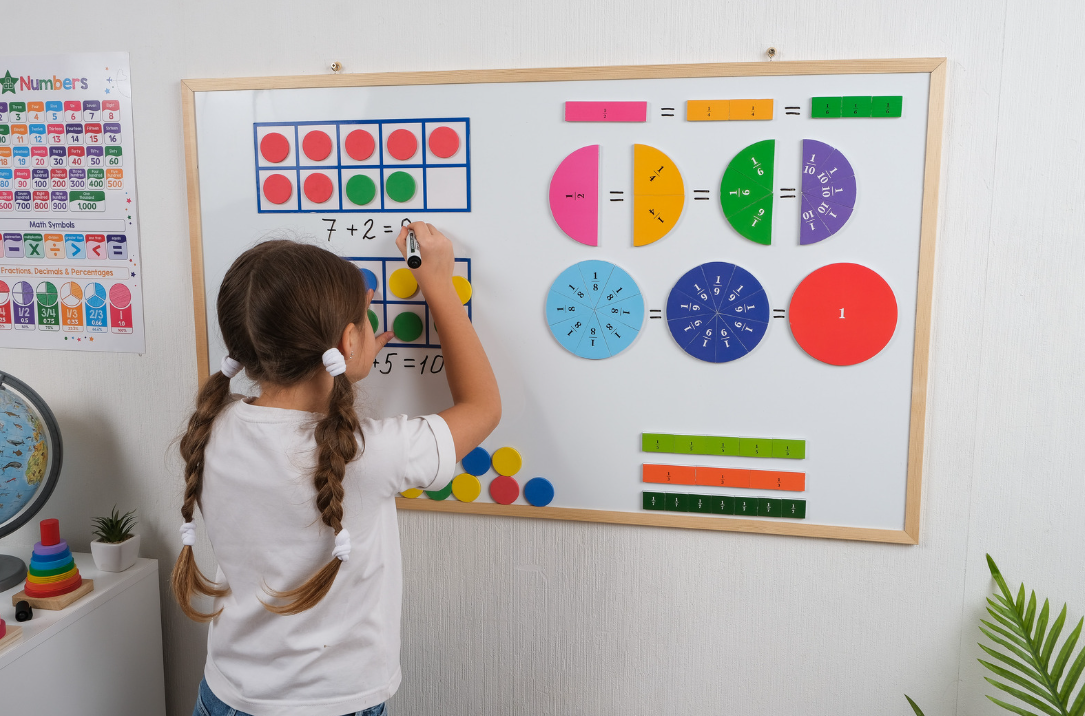
Primary maths increasingly emphasises multiple representations — concrete manipulatives, pictorial models and abstract notation. These representations help pupils see mathematical structure, make connections and develop flexibility.
Teaching assistants need confidence in:
- Using manipulatives such as counters, base ten equipment or fraction models
- Interpreting bar models, number lines and arrays
- Linking visual representations to symbolic mathematics
- Understanding why a particular representation is useful for a given concept
Without this understanding, representations risk becoming decorative rather than meaningful. When used well, they illuminate mathematical relationships and deepen conceptual understanding.
Teaching Assistant Maths Subject Knowledge CPD
Strengthening structure, language and independence in mathematics
This targeted professional development programme is designed to support maths leads in improving the impact and consistency of teaching assistant support across mathematics.
Delivered as two sessions or a full-day CPD in your school, the training focuses on developing teaching assistants’ subject knowledge and pedagogical understanding so that support in lessons or during intervention aligns closely with high-quality class teaching for mastery principles.
Article by

Lisa Heatherington
School Improvement Advisor
Primary Maths and English
lisa.heatherington@northtyneside.gov.uk